
Puppetry and the 250th Anniversary of America’s Declaration of Independence
By Jennifer Aguirre
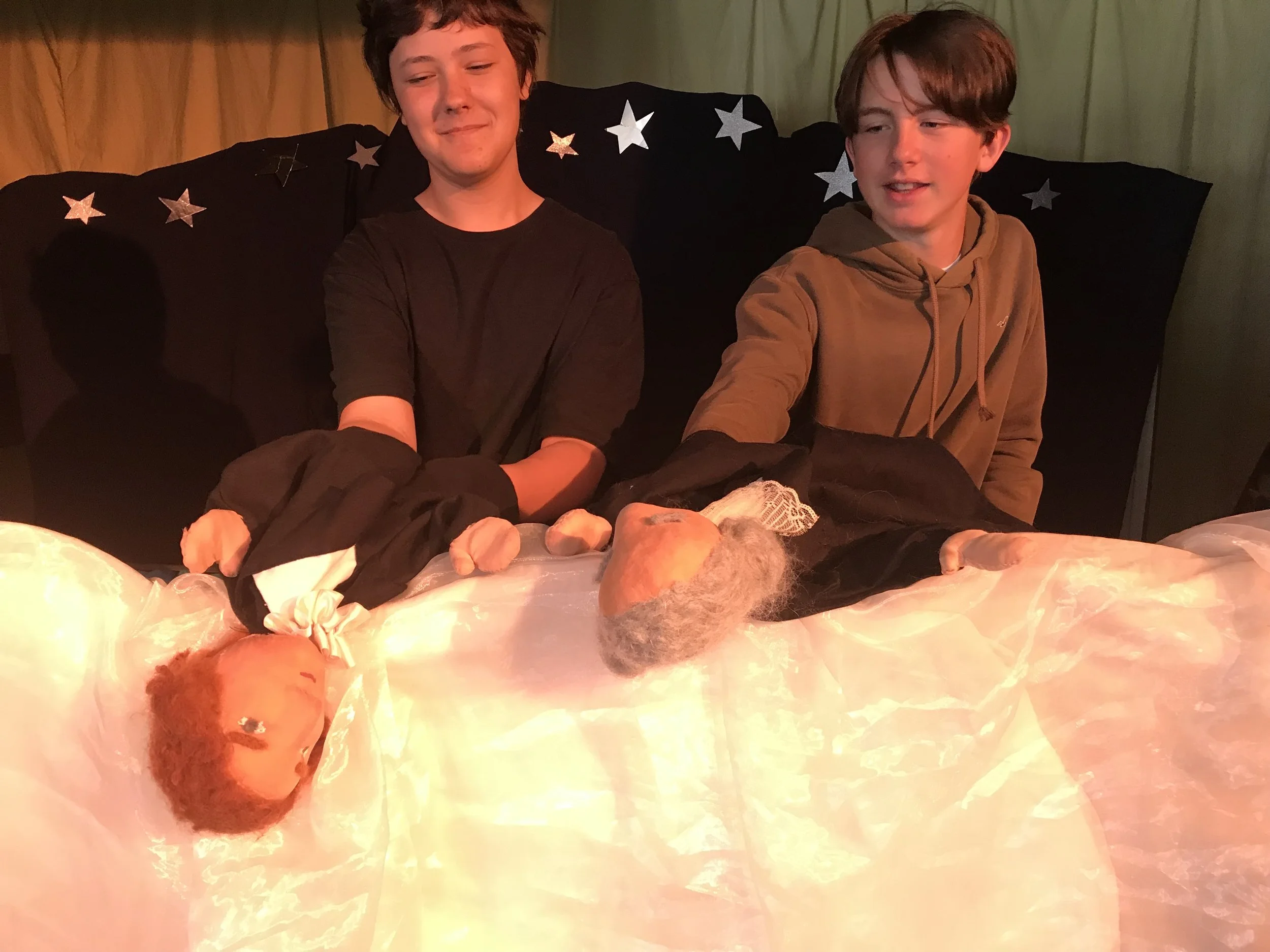
The 8th grade puppetry curriculum at the Sierra Waldorf School involves the making of a storytelling lap rod puppet of a biographical figure from history. The puppet heads are made from needle felted wool sculpture techniques and covered in silk gauze with glue-mache. The body gowns are sewn by machine with added hand sewn cameo design elements. The students choose from an extensive list of 19th and 20th century individuals who served and uplifted humanity for the common good. The puppetry project involves the students’ researching and writing a biography of their chosen individual and putting it into monologue or dialogue script form. The performance is within a simple stage setting of ‘heaven’ performed with a blending of well memorized lines expressed with feeling and life like movement with gesture. This can be challenging for a student puppeteer as it engages both sides of the brain. When done well, though, it is very effective.
This year’s 2026 school puppetry project, which was recently performed, approached this project from a different angle, focusing on the United States 250th anniversary of the Declaration of Independence. Specifically, we focused on the inspiring words that “ALL men are created equal” and included the ongoing evolution that everyone is included in the word “ALL.”
This year’s puppetry project involved a combined class of both 7th and 8th grade students of which ten students are boys and five are girls. The class has its own biography and any work with this class involves reigning in these ten rambunctious adolescent boys of which many are neurodiverse. The combined class includes four 8th grade students and eleven 7th grade students. This puppetry project is designed for 8th grade students but most 7th grade students are capable and I ‘ve brought this project to other combined classes of 7th and 8th in past years.
The idea to focus on the United States 250th anniversary came about last summer when I visited both Washington DC (including several Smithsonian museums) and Concord and Lexington, Massachusetts (where the American Revolutionary War first began in 1775). This puppetry project focus took root and required far more research on my part to shape the story that I envisioned to be portrayed through only 15 student biographical puppets. I gave the students a short list of biographies they could choose from and steered many of the students to choose a biography that I thought they would enjoy or simply whose story needed to be told. Overall, the students knew very little to begin with in the details of the biographies of America’s founding notables and they did not shy away from including the contradictions they found in their individuals’ biographies specific to slavery in their research and reports. As the project took shape, I had two 8th grade students become historian narrators for the performance to bridge the story line between the various biographies helping to convey the span of time we covered. These two historian narrators possessed a ‘portal to heaven’ so they could introduce all the individuals who were speaking from the past.
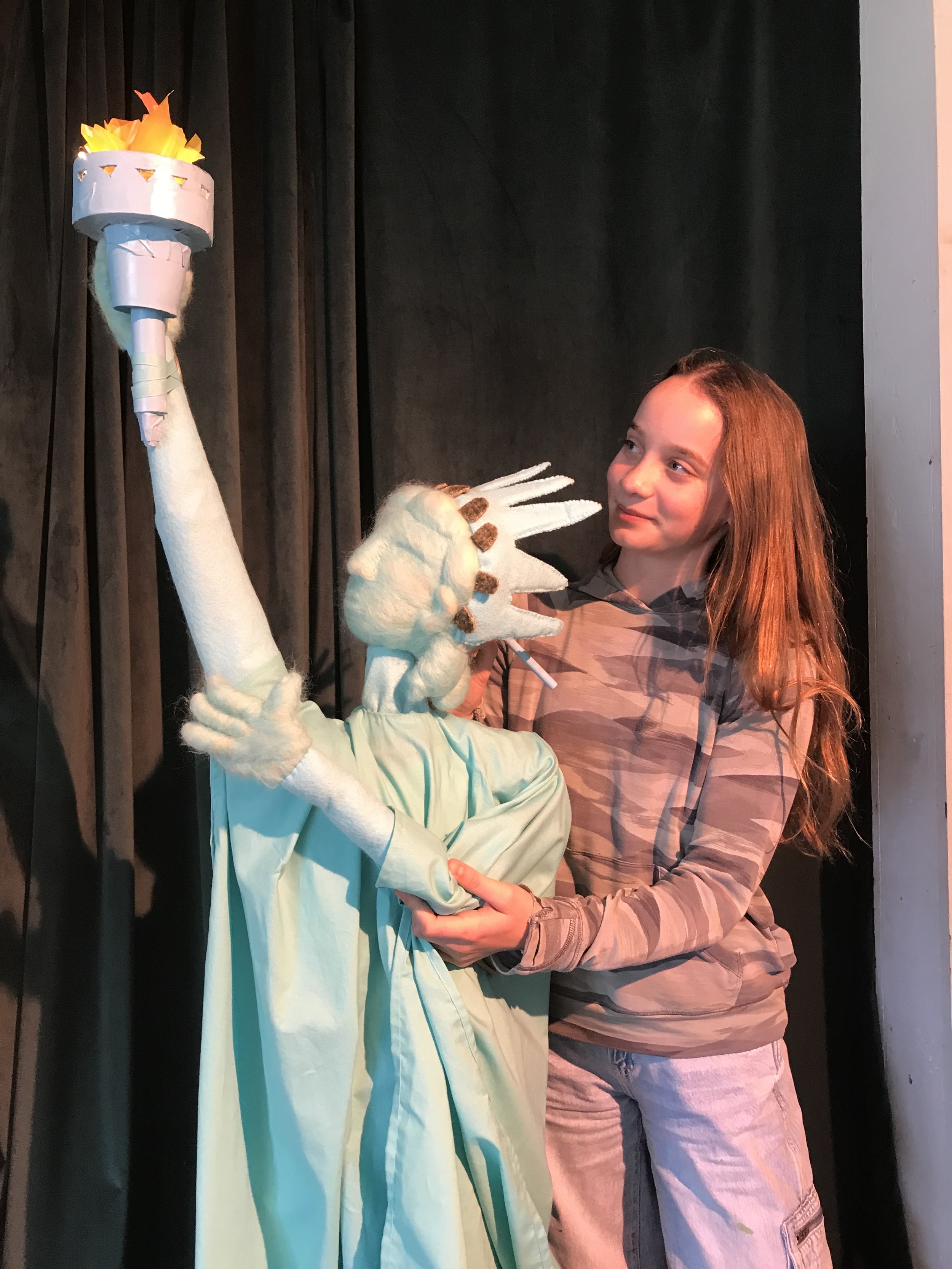
The performance also included a large Lady Liberty rod puppet who helped bring the overall story into the present time as a symbol of the United States’ rich history with immigrants, along with her broken chains at her feet representing the end of slavery and her tablet in her arm marked with July 4, 1776. The 8th grade student historian narrators began their narration with giving an overview of the founding dates of two early colonies and spoke of the first European contacts with the North American indigenous first peoples who inhabited this land long before the Europeans arrived. A brief telling of the Great Peacemaker was also included about the founding of the 5-nation Iroquois Confederacy (today known as the Haudenosaunee Confederation). This 5-nation confederacy (later 6) gave an example of separate nations united into one which influenced the writing of the US Constitution.
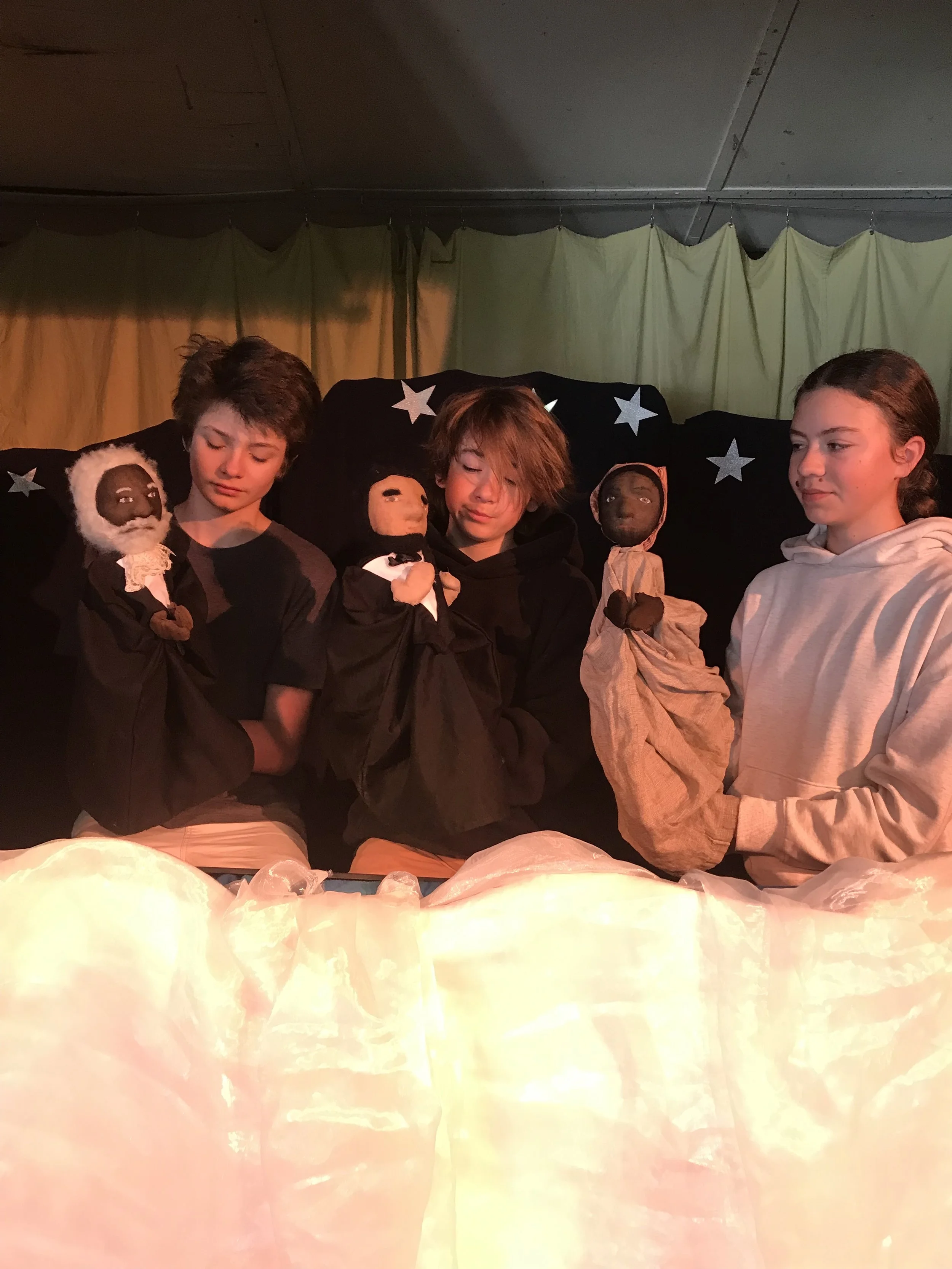
Listed here are the biographies of the individuals the students portrayed with a brief description of each. The script biographies were either shared individually, or in pairs (Abigail and John, Elizabeth and Susan) or as a trio from the Civil War era and the end of slavery (Abraham Lincoln, Harriet Tubman and Frederick Douglass):
Roger Williams 1603-1683
More than a century before the ratification of the United States Constitution, an English colonist named Roger Williams was experimenting with ideas of religious equality, civil participation, democracy, free speech, and personal liberty. In 1636, Williams founded the settlement of Providence, Rhode Island based on those guiding principles. He also had great respect and befriended the local indigenous people, writing a book about the Narragansett language and customs. There is a Roger Williams National Park in Providence, RI.
Benjamin Franklin 1706-1790
Benjamin Franklin was a printer, publisher, author, inventor, scientist, and diplomat. One of the foremost of the United States’ Founding Fathers who signed three key founding documents.
George Washington 1732-1799
George Washington is known as the ‘Father of the Nation.’ His leadership qualities led the Continental Army to victory in the Revolutionary War and he later served as the first president of the United States. Washington set precedence for the presidency and established the peaceful transfer of power. He was a farmer from the state of Virginia and owned hundreds of slaves who he freed in his will when he died. Washington dealt harshly with the indigenous people regarding their land.
John Adams 1735-July 4, 1826
John Adams of Massachusetts was one of the leaders of the American Revolution for independence from Great Britain. He was a farmer and the second president of the United States and later his son served as the 6th president, a vocal advocate for the abolishment of slavery. John and his wife, Abigail, saved thousands of their correspondence for historical records. Letters which they wrote to each other during John’s long absences while he helped establish the founding of the United States.
Abigail Adams 1744-1818
Abigail Adams is hailed for her now famous admonition that the Founding Fathers “remember the ladies” in their new laws. Abigail Adams was not only an early advocate for women's rights, but she was also a vital confidant and advisor to her husband John Adams. She was a farmer who opposed slavery and supported women's education.
Thomas Jefferson 1743- July 4,1826
Thomas Jefferson was the primary author of the Declaration of Independence. He served as the third president of the United States. He was a farmer in Virginia who owned hundreds of slaves. During his presidency he made the Louisiana Purchase with Napolean of France and supported an exploration of these newly purchased lands though the Lewis and Clark expedition. The new nation expanded in great size.
Phylis Wheatly 1753-1784
Phillis Wheatley earned acclaim as a poet, and historians recognize her as one of the first Black and enslaved persons in the United States to publish a book of poems. Born in West Africa, Wheatley became enslaved as a child and crossed the Atlantic in a slave ship. In 1761, John and Susanna Wheatley purchased her when she arrived in Boston and gave her an education and later her freedom.
Alexander Hamilton 1755 – 1757
Alexander Hamilton was born on one of the Caribbean islands and came to the American colonies as a young man to attain an education, paid for by island residents who recognized his writing abilities. Hamilton fought in the American Revolutionary War as an aid to George Washington. He helped draft the Constitution and advocated for its ratification through his co-authoring of the federalist papers. He was the founder and architect of the American financial system through his role as the first secretary of the treasury and was an advocate for a large central government. Hamilton died in a dual with a political rival, Aaron Burr.
Abraham Lincoln 1809-1865
Abraham Lincoln was 16th president of the United States, serving from 1861 until his assassination in 1865. He was a humble man born in a log cabin of simple means. He led the United States through the American Civil War, defeating the Confederate States and playing a major role in the abolishment of slavery.
Frederick Douglass 1818- 1895
In his journey from enslaved young man to a free man, Frederick Douglass became an internationally renowned abolitionist activist known for his oratory skills, books and his intelligence. Douglass served as a source of inspiration and hope for others.
Harriet Tubman 1822-1913
Harriet Tubman escaped slavery to become a leading abolitionist. She led dozens of fugitive slaves to freedom along the route of the Underground Railroad and later served as a spy in the Civil War.
Elizabeth Cady Stanton 1815-1902
Elizabeth Cady Stanton was an author, lecturer, and the chief philosopher of the woman's rights and suffrage movement. She formulated the agenda for woman's rights.
Susan B Anthony 1820-1906
Susan B Anthony was a good friend to Elizabeth Cady Stanton and together they worked tirelessly for women’s right to vote which finally came with the 19th amendment in 1920, many years after their deaths. Both women had visited our home area, Sonora, California, for a lecture tour in 1871.
Jacob Riis 1849–1914
Jacob Riis was a Danish-American immigrant who was a social reformer, "muck-raking" (investigative) journalist, and social documentary photographer. He had experienced firsthand the dire living conditions as an immigrant himself. Riis contributed significantly to the cause of urban reform in the United States at the turn of the twentieth century.
Chief Seattle 1780~86 –1866
Chief Seattle was a leader of the Duwamish and Suquamish peoples in what today is called the Puget Sound of the Pacific Northwest. A leading figure among his people, as a child Seattle witnessed the first encounter with Europeans when British Captain Vancouver maneuvered his ship into the Pugent Sound and took anchor. Seattle pursued a path of accommodation with white settlers but years later witnessed his peoples’ lands being overrun by settlers and the treaties he signed not respected nor followed by the United States government. Seattle was even prevented from entering the city that had been named after him. A widely publicized speech attributed to Seattle argued in favor of ecological responsibility and respect for Native Americans' land rights.
Toward the end of the performance, one of the students performed Lady Liberty followed by the whole student group sharing a portion of the poem written by Emma Lazarus, The New Colossus that is printed at the base of the Statue of Liberty, “Give me your tired, your poor. Your huddled masses yearning to breathe free…”
The narrators closed with Martin Luther King Jr’s words, “I have a dream that one day this nation will rise up, live out the true meaning of its creed: We hold these truths to be self-evident, that ALL are created equal” of which the whole student group chimed in to end the performance with these words: “with justice and liberty for all!”
The students did a great job, despite the mangling of a few mispronounced words here and there and perhaps some speaking too fast. Their parents, grandparents and other guests enjoyed the fruits of all their work. I was pleased, proud of the students’ work and all their effort and I was utterly exhausted at the end.
I’m grateful to Ken Burn’s documentary about the Revolution that aired in November 2025 and numerous other authors and historians’ books and articles I read. It’s fascinating history! And the United States of America’s stirring first principles words in its founding are still unfolding in real time today.